Handmade in Canada | The Balance Board Competitive Dancers Train On

Why Every Ballerina Needs a Balance Board for Training (2026)
Ballet asks your body to do something fundamentally unnatural: balance your entire weight on a surface the size of a coin, in shoes designed to extend your foot to its absolute limit, while making it look effortless.
Pointe work, pirouettes, extended adagio balances, landing jumps in fifth — every one of these demands proprioceptive control that goes far beyond what most athletes ever need. And yet most ballet training develops balance indirectly, as a byproduct of barre and centre work, rather than targeting the proprioceptive system directly.
A balance board changes that equation. By training on an unstable surface, you isolate and strengthen the exact sensory and muscular systems that keep you upright on demi-pointe, centred during turns, and stable through port de bras that shift your centre of gravity.
Here's why a balance board belongs in every serious ballet dancer's home training setup, and how to use one for ballet-specific development.
What Ballet Demands From Your Balance System
Ballet uses all four components of balance simultaneously, often at their extremes:
Ankle proprioception is arguably more important in ballet than in any other sport. Relevé, demi-pointe, pointe work — all require your ankle stabilizers to make rapid, precise corrections on a very small base of support. The metatarsals and intrinsic foot muscles provide the sensory input; the peroneals, tibialis posterior, and gastrocnemius/soleus complex provide the motor response. When this system is sharp, relevé feels solid. When it's dull, every balance feels precarious.
Hip stability controls your alignment during everything from développé to arabesque. The deep rotators (piriformis, obturator internus, gemelli) manage turnout while the gluteus medius controls pelvic levelness. On a stable floor, your hip stabilizers can rely on a fixed reference point. On a balance board, they have to work independently, which develops much deeper activation.
Core integration connects your upper and lower body. Port de bras, épaulement, and any movement where your arms move independently of your legs requires your core to transfer forces smoothly while maintaining balance. A balance board forces your core to stabilize in all planes simultaneously.
Vestibular processing manages spatial orientation during turns. Your inner ear tells your brain which way is up. In ballet, you deliberately disrupt this system with every pirouette, fouetté, and chaîné, then instantly reorient using spotting. Training on an unstable surface sharpens your vestibular system's ability to process conflicting sensory input — exactly what happens during turns.
Why At-Home Balance Training Matters for Dancers
Most ballet dancers train 10–20+ hours per week at the studio. That sounds like plenty, but very little of that time is dedicated to isolated proprioceptive work. Barre develops it passively. Centre builds on it. But nobody stands at barre for 10 minutes specifically training their ankle proprioception — there isn't time in a class format.
Home balance board training fills this gap. Ten minutes daily — before school, before bed, during a show on TV — provides focused proprioceptive work that complements everything happening in the studio. It's the same principle as practising relevés at home or doing Thera-Band foot exercises: targeted supplemental training that makes your studio time more productive.
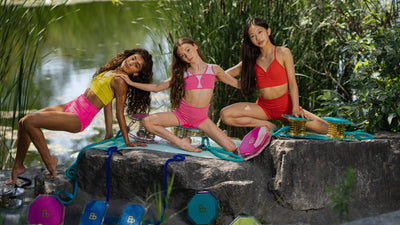
The Bellenae spring balance board was created by five sisters who danced their entire lives — designed for the specific balance demands of ballet, figure skating, and competitive dance
See How It Works →Ballet-Specific Balance Board Exercises
Relevé Hold
Stand on the board in parallel or first position. Rise slowly to demi-pointe and hold. Start with 10-second holds and build to 30 seconds. The springs create constant micro-movements that force your ankle stabilizers to work continuously — on a stable floor, you can find a balance point and hold it statically. On springs, the balance point is always shifting, which builds reactive ankle stability.
Why it transfers: Every time you relevé in class — during tendu, during adagio, during pirouette prep — your ankle is managing small perturbations. Training on an unstable surface makes these perturbations feel smaller by comparison.
Single-Leg Relevé
Shift your weight to one foot on the board and rise to demi-pointe. This is significantly harder than two-foot relevé because your single ankle has to manage all the board's instability alone. Hold for 5–10 seconds and build gradually. Alternate sides, spending extra time on your weaker leg.
Why it transfers: Pirouettes, piqué turns, single-leg balances in adagio — all happen on one foot in relevé. If you can hold a controlled single-leg relevé on a spring balance board, a stable studio floor feels dramatically more secure.
Développé with Board Stance
Stand on the board on one leg. Slowly développé the working leg to the front, side, or back while maintaining your balance on the standing leg. The speed should be slower than you'd use in class — the goal isn't height or extension, it's maintaining the standing leg's stability while the working leg moves.
Why it transfers: Développé in centre challenges your balance because the working leg's weight shifts your centre of gravity. Training this on an unstable surface teaches your standing leg to compensate automatically, which means smoother, more controlled développés in class.
Port de Bras Balance Challenge
Stand on the board in a comfortable position (two feet at first, then single leg as you progress). Perform slow, classical port de bras — bras bas to first, first to fifth, fifth to second, second to bras bas. Then add cambré forward and back.
Why it transfers: Port de bras shifts your centre of gravity. On the board, every arm movement changes the balance equation, forcing your core and legs to adapt continuously. This builds the integration between upper body artistry and lower body stability that separates good dancers from exceptional ones.
Turnout Maintenance Under Instability
Stand on the board in first position. Focus on maintaining your turnout while the board moves underneath you. The instability will try to pull your feet into parallel — resisting this is precisely the deep rotator engagement you want. Hold for 30–60 seconds, then switch to fifth position for an additional 30 seconds.
Why it transfers: Maintaining turnout during dynamic movement is one of ballet's greatest challenges. This exercise trains your deep rotators to fire automatically under unstable conditions — exactly what's needed during turns and jumps.
Plié to Relevé Flow
Stand on the board in first or second position. Perform a slow demi-plié (4 counts down, 4 counts up), then immediately rise to relevé (2 counts up, hold 4 counts, 2 counts down). Repeat 5–8 times. This continuous flow trains your proprioceptive system through the full range of vertical movement that ballet demands.
Why it transfers: The plié-relevé transition is fundamental to ballet movement. Training this on an unstable surface builds the neuromuscular coordination that makes jumps cleaner and landings more stable.
The Bellenae Spinning Balancer combines spin training with spring-based balance work — the only board designed for both pirouette training and proprioception development
Explore the Collection →How to Fit Balance Board Training Into a Ballet Schedule
Before class (5 minutes): Basic relevé holds and single-leg stance as a proprioceptive warm-up. This primes your stabilizer muscles before you start barre work, leading to sharper balance from the first exercise.
After class (10 minutes): More challenging exercises — développé balance, port de bras challenge, plié-to-relevé flow — while your body is warm and your muscles are activated. Post-class is when you have the most body awareness, making it the ideal time for proprioceptive training.
Rest days (15–20 minutes): Full balance board session covering all exercises. This is valuable low-impact training that maintains your proprioceptive sharpness without adding the impact stress of jumping or the joint stress of turnout work.
Competition week: Reduce to basic relevé holds and gentle single-leg stands only. Maintenance mode — you don't want to introduce new challenges or fatigue your stabilizers before performance.
The Difference a Balance Board Makes
The change isn't dramatic overnight. It's cumulative. After two to three weeks of daily balance board training, most dancers notice their relevé feels more secure — not because they've gotten stronger, but because their corrections are faster and smaller. They wobble less. They recover from small balance disruptions without panicking.
After four to six weeks, the improvement shows up in class. Pirouettes feel more centred because the standing ankle manages the rotational instability automatically. Adagio balances last longer because the hip stabilizers are engaging more deeply. Jump landings feel more controlled because the proprioceptive system is processing ground reaction forces faster.
After three months, it becomes part of how your body works. Your teacher might comment that your balances have improved, but from your perspective, everything just feels more natural. That's the sign that the training has done its job — the proprioceptive system is operating at a higher level without conscious effort.
Frequently Asked Questions
What age should ballet dancers start using a balance board?
Most ballet students can begin basic balance board work around age 8–9. Start with two-foot standing only, with a parent or teacher nearby as a spotter. The Bellenae Mini is designed for younger and lighter dancers. Don't introduce single-leg or eyes-closed work until the dancer is comfortable and confident on the board.
Will a balance board help with pointe readiness?
Yes. Pointe readiness requires sufficient ankle strength, proprioception, and core stability. Balance board training addresses all three — the unstable surface strengthens the intrinsic foot muscles and ankle stabilizers while building the proprioceptive control that pointe work demands. It's not a substitute for your teacher's assessment of readiness, but it accelerates the development of the systems pointe work requires.
I already do Thera-Band exercises for my feet. Do I need a balance board too?
They train different things. Thera-Band exercises build muscular strength in isolation — flexion, extension, eversion, inversion against resistance. Balance board training builds proprioceptive integration — the ability of multiple muscle groups to coordinate in real-time under unstable conditions. Both are valuable. The Thera-Band builds the raw strength; the balance board teaches your body to use that strength reactively.
Should I use the balance board in ballet shoes or barefoot?
Both have value. Barefoot training engages the intrinsic foot muscles more directly and provides better sensory feedback through your feet. Training in soft ballet shoes simulates the reduced grip and altered sensory input of dancing in shoes. Alternate between both for the most comprehensive training.
Can a balance board help with pirouette consistency?
Yes, through two mechanisms. First, it sharpens your standing ankle's ability to manage the rotational forces of a turn without losing its centre. Second, it trains your vestibular system to recover spatial orientation faster, which improves your spotting and your ability to stop a turn cleanly. The Bellenae Spinning Balancer adds actual rotational practice to these benefits, making it particularly effective for turn training.
The Bellenae Collection


Get Our Free Balance Board Training Plan
Join our community of competitive dancers and athletes. Get training tips and exclusive deals delivered to your inbox.
Train With Bellenae
Used by competitive dancers, gymnasts, and figure skaters across Canada.


Free 4-Week Balance Board Training Plan
Join competitive dancers and athletes worldwide. Get training tips + exclusive deals.