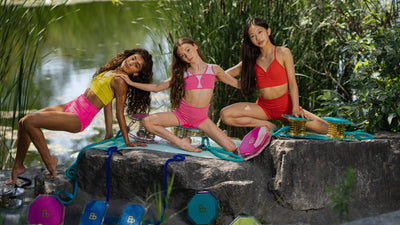
Handmade in Canada | The Balance Board Competitive Dancers Train On

Spring Balance Board vs. Wobble Board: What's the Difference (and Which One Is Right for You)?
Spring Balance Board vs. Wobble Board: What's the Difference (and Which One Is Right for You)?
Walk into any athletic training store and you'll see balance boards of all shapes, sizes, and price points. They can look similar from a distance, but a spring balance board and a wobble board train very differently — and for dancers, gymnasts, and figure skaters, that difference matters a lot. Here's an honest breakdown.

Not all balance training tools are equal — the type of instability matters as much as the training itself.
What Is a Wobble Board?
A wobble board is a flat circular disc with a rounded or domed bottom. You stand on it and the board tilts and rocks in any direction. It challenges your ankle stability and basic proprioception, particularly when you're new to balance training.
Wobble boards are widely available, relatively inexpensive, and do provide a real training stimulus — especially for rehabilitation, general fitness, or beginners building basic ankle awareness. They've been used in physiotherapy for decades for good reason.
The limitation: the resistance is passive. The board wobbles in response to your movement, but it doesn't push back. Once your proprioceptive system adapts to the stimulus — which happens faster than most people expect — the board stops providing meaningful training.
What Is a Spring Balance Board?
A spring balance board uses a spring mechanism (or multiple springs) mounted between the platform and a base. When you stand on the platform, the springs provide active, continuous resistance. Your muscles have to work against that resistance to find and maintain center — and that demand doesn't go away the same way a wobble board's challenge does.

Spring boards offer a different training stimulus than wobble boards — and for dancers, that difference is significant.
The spring mechanism also allows for much more specific training configurations. You can have single-foot platforms, double-foot platforms, spinning mechanisms for pirouette and rotation training, and different spring tensions for different resistance levels. This makes spring boards significantly more versatile as a long-term training tool.
Bellenae makes handcrafted spring balance boards in Canada — built specifically for competitive dancers, gymnasts, and figure skaters, with medical-grade springs that hold up to serious daily training.
For Competitive Dancers
Serious dancers cross-train off-stage to build the proprioception and ankle stability that wins on stage. See how the Bellenae spring balance board is designed specifically for competitive dance training.
See the Bellenae Balance Board →How Do They Compare Side by Side?
Resistance quality: Spring boards provide active, progressive resistance. Wobble boards provide passive instability. For building the sustained muscle engagement dance demands, spring wins clearly.
Specificity: Spring boards can be designed with single-foot platforms, spinning mechanisms, and variable tension. Wobble boards are one size fits all. For sport-specific training, spring boards are the better tool.
Longevity of training stimulus: Spring boards continue to challenge you as you improve. Wobble boards plateau relatively quickly.
Price: Wobble boards are cheaper. Spring boards are an investment — but they're a training tool you use for years, not months.
Best for beginners: Either works. But if budget allows, starting on a spring board means you won't outgrow it.
Which One Is Right for You?
If you're a competitive dancer, gymnast, or figure skater training seriously — a spring balance board is the better investment. The active resistance, the specificity of training options (especially spinning boards for turn training), and the long-term scalability all point in one direction.
If you're a beginner doing general fitness, rehabilitation, or casual balance work — a wobble board is a reasonable starting point and significantly more affordable.
For the dancer who wants to improve their arabesque, clean up their pirouettes, and build the proprioceptive foundation that holds up under competition pressure — a spring balance board built for dance is the answer. It's not a gimmick. It's a tool that works, if you use it with intention.

The Bellenae spring board's resistance profile is designed specifically for dance and gymnastics applications.
Train Like the Best
The boards used by competitive dancers and athletes worldwide.
 The Bellenae Balancer
 The Bellenae Mini
 10" Spinning Board
 Double Spinning Balancer
Keep Reading
See the Bellenae Difference
Handcrafted in Canada with medical-grade springs. The Bellenae balance board delivers the dynamic, multi-directional instability that serious athletes need.
See the Bellenae Board →See the Bellenae Difference
Handcrafted in Canada with medical-grade springs. The Bellenae balance board delivers the dynamic, multi-directional instability that serious athletes need.
See the Bellenae Board →Frequently Asked Questions
Is a wobble board useless?
No. Wobble boards are effective for basic rehabilitation, introductory balance training, and casual fitness use. They're a good entry point. The limitation is that they provide predictable, single-plane instability that your body adapts to relatively quickly. For athletes and performers who need progressive, multi-directional balance training, a spring board provides a more demanding and effective long-term training stimulus.
Can I start with a wobble board and upgrade later?
Yes, and many people do. If you're new to balance training, a wobble board teaches you the basics of unstable surface training. When it starts feeling easy (typically within 2-4 weeks of regular use), that's the signal to move to a spring board for continued progression.
Why are spring boards more expensive than wobble boards?
The construction is fundamentally different. A wobble board is a single piece of plastic or wood on a dome — simple to manufacture. A spring balance board uses multiple medical-grade springs housed between two precision-cut platforms, with non-slip surfaces and hardware that must withstand sustained dynamic loading. The materials, engineering, and handcrafted construction reflect this difference.
Do physical therapists prefer one type over the other?
For early-stage rehabilitation, wobble boards are standard because they provide controlled, predictable instability. For later-stage rehab and return-to-sport protocols, many physiotherapists transition patients to spring boards because the multi-directional, progressive instability better prepares the joint for real-world demands. Both have a place in a rehab progression.
Which type is safer?
Both are safe when used appropriately. Spring boards feel more challenging because the instability is less predictable, but the springs also provide progressive resistance — the further the board tilts, the harder the springs push back, which creates a natural safety mechanism. Wobble boards have a hard tipping point with no graduated resistance, which can cause sudden loss of balance if you exceed the tilt range.
The Bellenae Collection
Get Our Free Balance Board Training Plan
Join our community of competitive dancers and athletes. Get training tips and exclusive deals delivered to your inbox.
Train With Bellenae
Used by competitive dancers, gymnasts, and figure skaters across Canada.


Free 4-Week Balance Board Training Plan
Join competitive dancers and athletes worldwide. Get training tips + exclusive deals.